


We develop the best technologies for recycling materials to find innovative solutions for the energy and ecological transition
STOKKERMILL | SELTEK SRL © 2023 | P. Iva. IT02360630301 | Privacy | Terms








In the context of the energy transition, end-of-life management of photovoltaic modules is critical. Stokkermill stands out as a leading manufacturer of solar panel recycling equipment, capable of processing monocrystalline, polycrystalline, thin-film, and bifacial modules. Its solar panel recycling system enables the recovery of up to 99.8% of materials by weight, delivering a sustainable and cost-effective solution and positioning the company as a benchmark for the circular economy in the solar industry.

A key differentiating feature of the Stokkermill solution is its evolutionary design. The proposed line can be easily upgraded into a fully automated Stokkermill SOLAR series plant, suitable for processing monocrystalline, polycrystalline, and damaged photovoltaic panels, including modules with aluminum frames still attached.
This approach turns the initial investment in an Entry-Level EL solar panel recycling system into a long-term strategy, enabling operators to increase throughput capacity without disrupting or redesigning the original installation. The base system already delivers a production input ranging from 800 to 1,000 kg/h, providing the flexibility required to handle growing volumes and to progressively transition toward a fully automated solar panel recycling line, while optimizing ROI and operational efficiency.
The technological core of this Entry-Level EL solar panel recycling system is based on the use of purely mechanical separation technologies, such as the XRS Series delamination mill, which eliminate the need for costly and environmentally impactful chemical or thermal treatments. This technical choice makes photovoltaic panel recycling both highly sustainable and safe.
A major operational advantage is that the system does not require prior removal of the aluminum frame, significantly reducing processing time and manual labor. Despite the abrasive nature of glass, the delaminator is engineered for predictive maintenance with limited downtime and controlled costs, ensuring that the solar recycling plant maintains high operational efficiency while keeping unplanned shutdowns to a minimum.
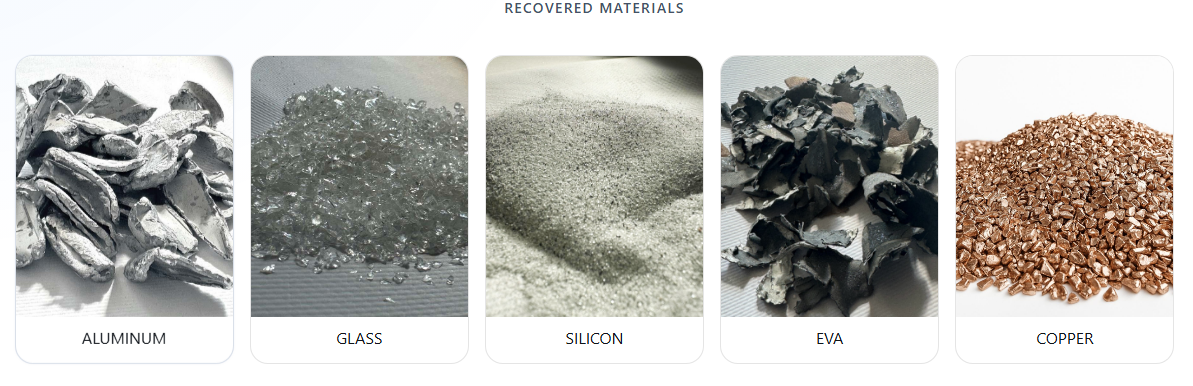
The effectiveness of a photovoltaic panel recycling plant is measured by the quality of the secondary raw materials it produces, and the Stokkermill solution sets the benchmark for solar panel material recovery. Glass, which accounts for approximately 70% of a module’s total weight, is recovered with a particle size ranging from 4 to 10 mm. The coarser fraction is clean and market-ready, while the finer fraction is suitable for reuse in the ceramics industry.
At the same time, the process ensures high-efficiency aluminum recovery (about 18% of total weight), achieving purity levels between 95% and 99%. This aluminum exits the plant as “furnace-ready” material—uncontaminated and compliant with End-of-Waste criteria—making it suitable for direct reintegration into downstream metallurgical processes. This maximizes the economic value of photovoltaic module recycling.
Beyond structural materials, solar panel recycling using Stokkermill technology enables the recovery of high-value strategic materials. The system extracts copper (1–2% by weight) from conductors and electrical connections, producing a high-quality recycled material.
Equally significant is the recovery of silicon (8–10%), which is separated as a concentrated fraction. This material contains recoverable residues of silver and other precious metals, making further downstream recovery through chemical and physical processes economically attractive.
The plastic fraction (polymers and EVA), representing approximately 5% (PPM), is also recovered. Thanks to its good calorific value, it can be converted into an alternative energy source through energy recovery processes.
The Entry Level photovoltaic recycling plant is designed to combine high throughput with low energy consumption—a key factor in ensuring the economic sustainability of the recycling process. With an installed power of 140 kW and an average operating load of around 100 kW, the system achieves a specific energy consumption of less than 1 kW per panel.
The fully automated solar panel recycling line is controlled by a PLC that continuously monitors operating parameters and energy usage, allowing precise machine adjustment and optimization. This advanced automation enables the entire plant to be operated by just two personnel: one responsible for material handling and one overseeing process control. The result is a streamlined, safe, and highly efficient photovoltaic panel recycling operation.
02/02/2026
This website uses cookies
We use cookies to improve user experience, analyse site traffic and personalise content. By clicking "Accept all" you consent to the use of all cookies. You can manage your preferences via "Cookie settings". For more information, read our Cookie Policy.
Strictly necessary cookies
Required for the website to function. No consent needed.
Analytics cookies
Google Analytics — anonymous statistics about site usage.
By continuing to browse without making a selection, you consent only to strictly necessary cookies. Read our Privacy Policy and Cookie Policy. You can update your preferences at any time from the footer of this website.