


We develop the best technologies for recycling materials to find innovative solutions for the energy and ecological transition
STOKKERMILL | SELTEK SRL © 2023 | P. Iva. IT02360630301 | Privacy | Terms






The market for recycling Waste Electrical and Electronic Equipment (E-Waste / WEEE) is no longer just about disposal. The challenge of modern Urban Mining is extracting secondary raw materials with "ready-to-furnace" purity levels, while keeping operational costs under control.
The complexity of modern materials requires a technological shift. Traditional technologies struggle to fully liberate metals or recover precious powders. At Stokkermill, we answer this need with an integrated approach that combines robust Italian mechanics with the most advanced vision technologies in the world.
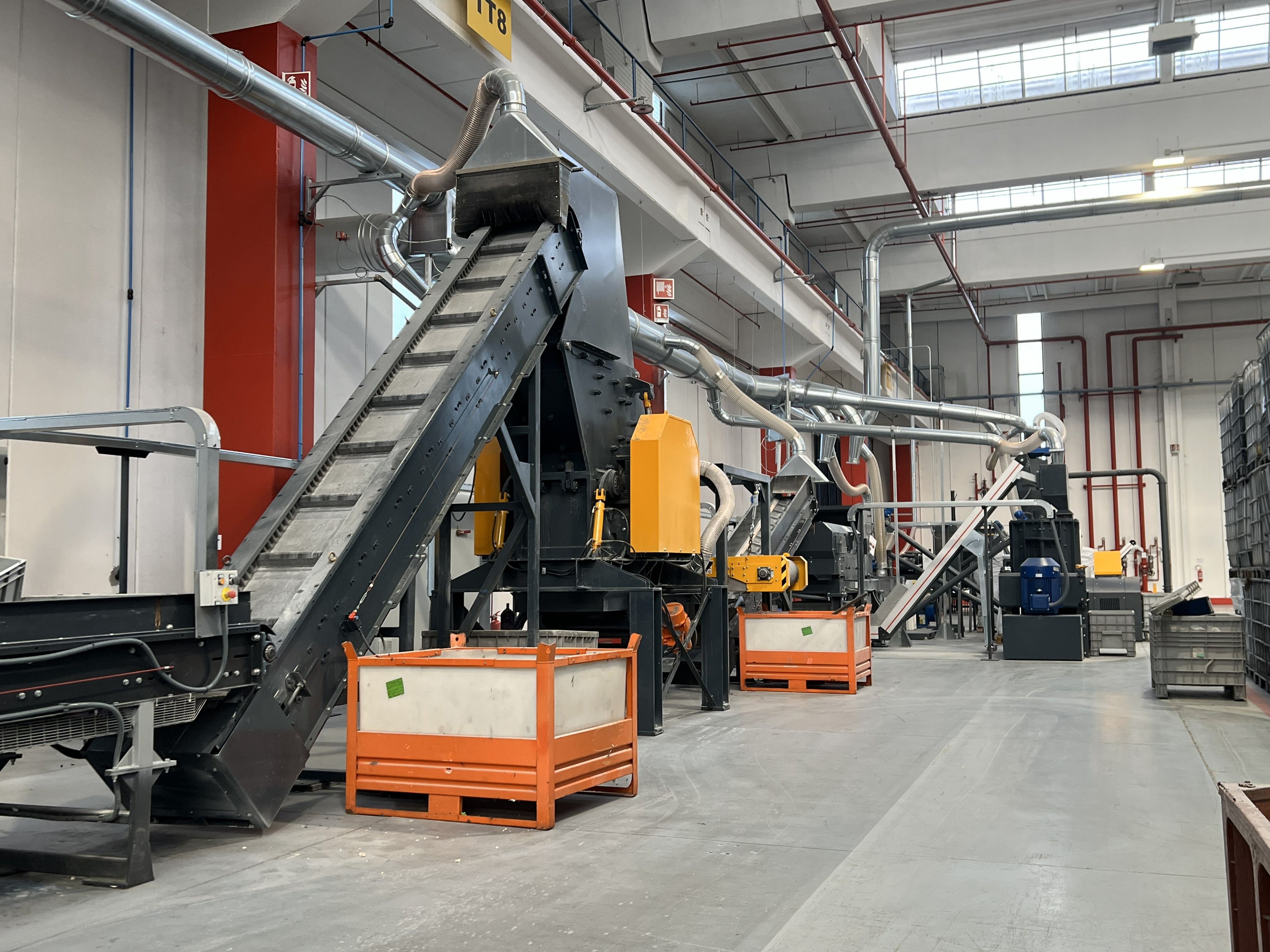
An efficient plant begins well before fine separation. To ensure downstream machines operate at 100% capacity, material must be properly prepared and classified. Integrating our Horizontal Trommel Screens is the fundamental first step: by classifying material into homogeneous particle sizes, we feed the subsequent lines constantly, avoiding the bottlenecks typical of mixed flows.
This is where the true material transformation occurs. In treating massive mixed E-Waste, choosing the right refining technology is critical. While our Turbo Granulators remain engineering masterpieces ideal for refining cables and pre-selected materials, massive and contaminated E-Waste flows require a different solution: the Vertical Refining Mill (VM Series).
This machine is specifically designed for heavy-duty workloads and to "get its hands dirty" where other technologies would stop:
• Large Input: The VM accepts input material sizes up to 50 mm (2 inches) and above. This simplifies the upstream line, accepting coarsely pre-shredded material.
• Immunity to Iron: This is a decisive strength. Unlike turbines or blade mills, the Vertical Mill does not fear ferrous parts. If a piece of iron or steel accidentally enters the chamber, it is processed and ejected without causing breakage or downtime, ensuring absolute operational continuity.
• Metal Densification: Its mechanical impact action hammers the metal until it is compacted into dense granules, completely liberating them from plastics and varnish.
Thanks to the action of the Vertical Mill, which delivers a compact and heavy granule, the subsequent phases reach maximum efficiency:
• Dry Densimetric Tables: Receiving densified metal (rather than filamentous), the separation from plastic via gravity becomes sharp and immediate.
• Electrostatic Separation (E-Sorting): The winning weapon for fine fractions. Where others lose material, our systems recover micro-particles of precious metals (under 2mm), turning what others consider waste into net profit.
4. Stokkermill Vision: Optical, X-Ray, and Short Supply Chain
When density is no longer enough to distinguish materials (e.g., Copper vs. Brass vs. Aluminum or black plastics), the Stokkermill Vision Project comes into play.
The "Manufacturer-to-Manufacturer" Strategy For Optical and X-Ray Sorters, we have chosen to collaborate directly with manufacturers in Japan and South Korea, undisputed global leaders in precision imaging. We have eliminated all commercial intermediaries, purchasing hardware directly from the source. This shortening of the supply chain allows us to offer Top-Tier technology at extremely competitive prices, skipping distributor markups.
The Italian Brain The Asian hardware arrives in Udine (Italy) to be integrated with Stokkermill Control Software and Electronics. We are the ones who calibrate the algorithms on the most complex electronic scrap specifications, ensuring the infallible separation of red metals from white metals.
Grinding is not enough. To dominate the market today, you need a perfect sequence: Robust Refining (Vertical Mill) + Intelligent Vision (Vision Project). Stokkermill solutions unite the best Asian technology, Italian process engineering, and a direct supply chain to offer you maximum technical yield at the best quality-price ratio.
Want to see how the Vertical Mill handles your ferrous and non-ferrous materials? Come visit us in Udine, Italy. Let's test our machines with your samples.