


We develop the best technologies for recycling materials to find innovative solutions for the energy and ecological transition
STOKKERMILL | SELTEK SRL © 2023 | P. Iva. IT02360630301 | Privacy | Terms








When buyers evaluate industrial recycling equipment, they focus on specifications, throughput capacity, motor power, separation efficiency. These numbers matter. But they say nothing about what happens to the machine after 12 months of continuous operation in a real recycling environment, when bearing fatigue, structural vibration and surface corrosion start revealing the true quality of how the machine was built.
At Stokkermill, we have been manufacturing industrial recycling machinery for over 30 years. Every solar panel recycling line, every WEEE treatment system, every shredder and separation plant that has left our production floor was built through the same uncompromising process, from the first engineering drawing to the final test before shipment. This article explains what that process looks like, and why it matters.
Made in Italy is a label. What it means in practice depends entirely on what happens inside the factory.
At Stokkermill, it means that every critical component of every machine we build is designed, machined, fabricated and assembled in-house by our own team. We do not outsource rotating components, structural fabrication or surface treatment to third-party suppliers. The engineers who design a component are the same people who oversee its production and support it in the field after installation.
This level of vertical integration is not common in the recycling machinery industry. It requires sustained investment in qualified personnel, precision equipment and production management. But it eliminates the quality variability that comes with outsourced manufacturing and it means that when a machine ships from our facility, we know exactly what is inside it, because we built every part of it.

The most demanding components in any recycling machine are the rotating ones: rotors, shafts and bearing housings. These components operate under high dynamic loads, at continuous speed, for years, and they must maintain dimensional accuracy throughout their service life to avoid premature failure.
At Stokkermill, all critical rotating components are machined in-house on our own equipment, to tolerances measured in hundredths of a millimetre. Bearing journal surfaces are ground to mirror finish. Disc centre bores are finished for correct interference fit. Every component is dimensionally verified before assembly.
The consequences of cutting corners at this stage are well understood in the industry. A bearing seat machined out of tolerance means premature bearing failure under operational load. A rotor that does not balance correctly means vibration, noise and accelerated wear propagating through every connected component. These are the most common causes of unplanned downtime and high maintenance costs in recycling operations worldwide.
We eliminate these failure modes before the machine leaves our production floor. This is how we build. This is why it lasts.
.jpeg)
Here is a detail most buyers never ask about and that separates machines built to last from machines built to a price point.
Not all manufacturers sandblast their structures before painting. We do. Every frame, every housing, every structural component. Without exception.
Steel that comes directly from fabrication is covered in mill scale, weld oxidation and surface contamination. Paint applied over this surface does not bond to the steel, it bonds to the contamination layer. When that layer fails, as it will in the dust, moisture and abrasion of a recycling environment, the coating delaminates and corrosion begins from the inside. The machine degrades invisibly, until the damage becomes structural.
Sandblasting removes all mill scale, rust and contamination down to clean bare metal and creates a controlled surface profile that allows industrial coating systems to bond mechanically to the steel. The result is a finish that resists impact, moisture penetration and chemical attack for years longer than paint applied to unprepared steel.
All Stokkermill structures are blast-cleaned to heavy industrial specification before any surface treatment is applied. It costs more. It takes longer. We do it anyway.
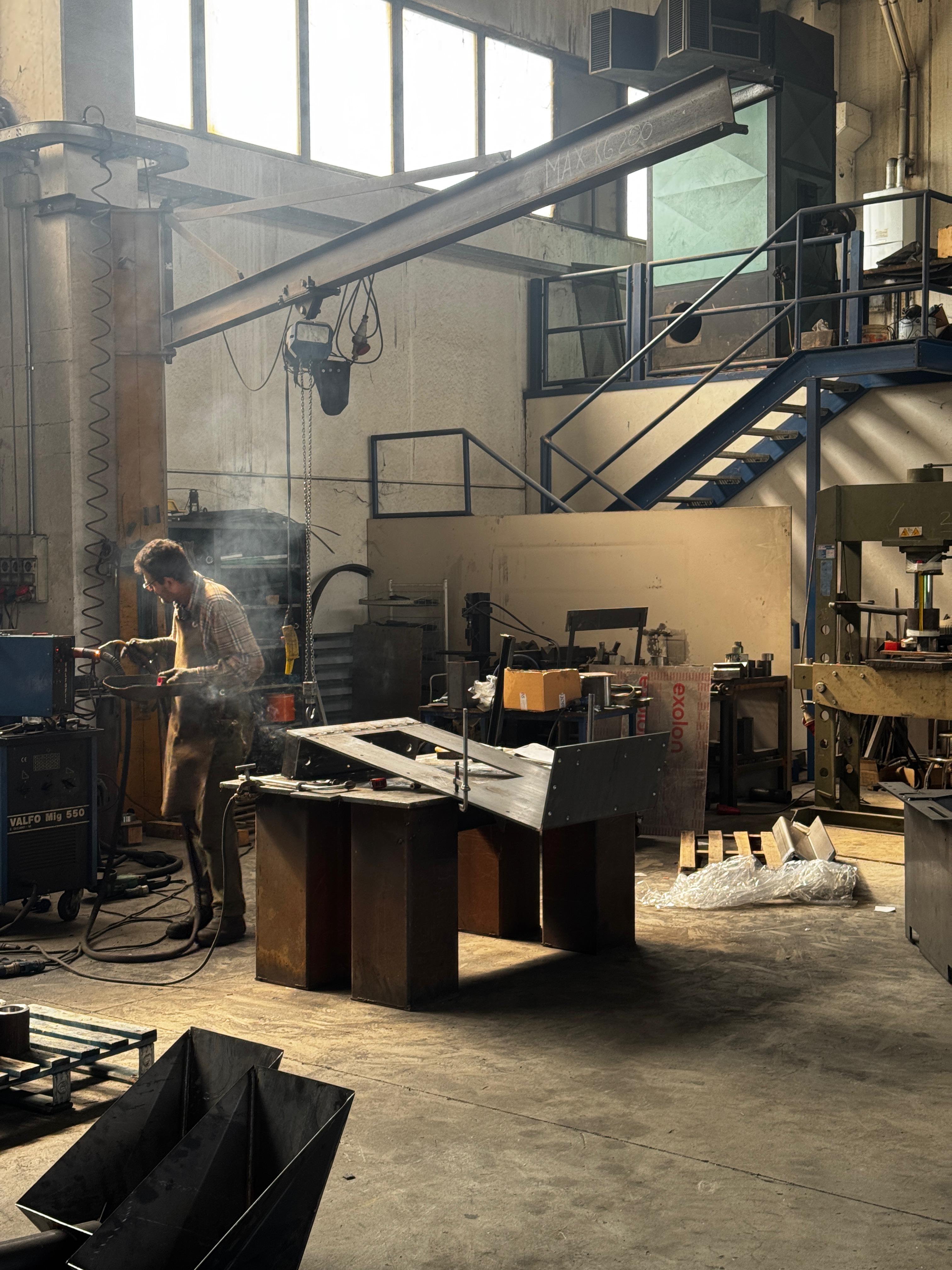
Every Stokkermill machine starts the same way. Not with a brochure. Not with a render. With a welder, a piece of steel, and twenty years of knowing exactly what to do with both.
Our production floor is where all structural fabrication happens: frames cut, bent and welded to engineering drawings; housings and chutes formed to precise geometry; complete assemblies built up component by component on precision fixtures that maintain dimensional accuracy throughout the welding process. Our welders work to qualified procedures specifying preheat requirements, interpass temperatures and electrode specifications because the mechanical properties of a weld joint are determined during welding, not visible afterwards.
Stokkermill — Engineering recycling solutions. Made in Italy.
14/05/2026
This website uses cookies
We use cookies to improve user experience, analyse site traffic and personalise content. By clicking "Accept all" you consent to the use of all cookies. You can manage your preferences via "Cookie settings". For more information, read our Cookie Policy.
Strictly necessary cookies
Required for the website to function. No consent needed.
Analytics cookies
Google Analytics — anonymous statistics about site usage.
By continuing to browse without making a selection, you consent only to strictly necessary cookies. Read our Privacy Policy and Cookie Policy. You can update your preferences at any time from the footer of this website.