


We develop the best technologies for recycling materials to find innovative solutions for the energy and ecological transition
STOKKERMILL | SELTEK SRL © 2023 | P. Iva. IT02360630301 | Privacy | Terms







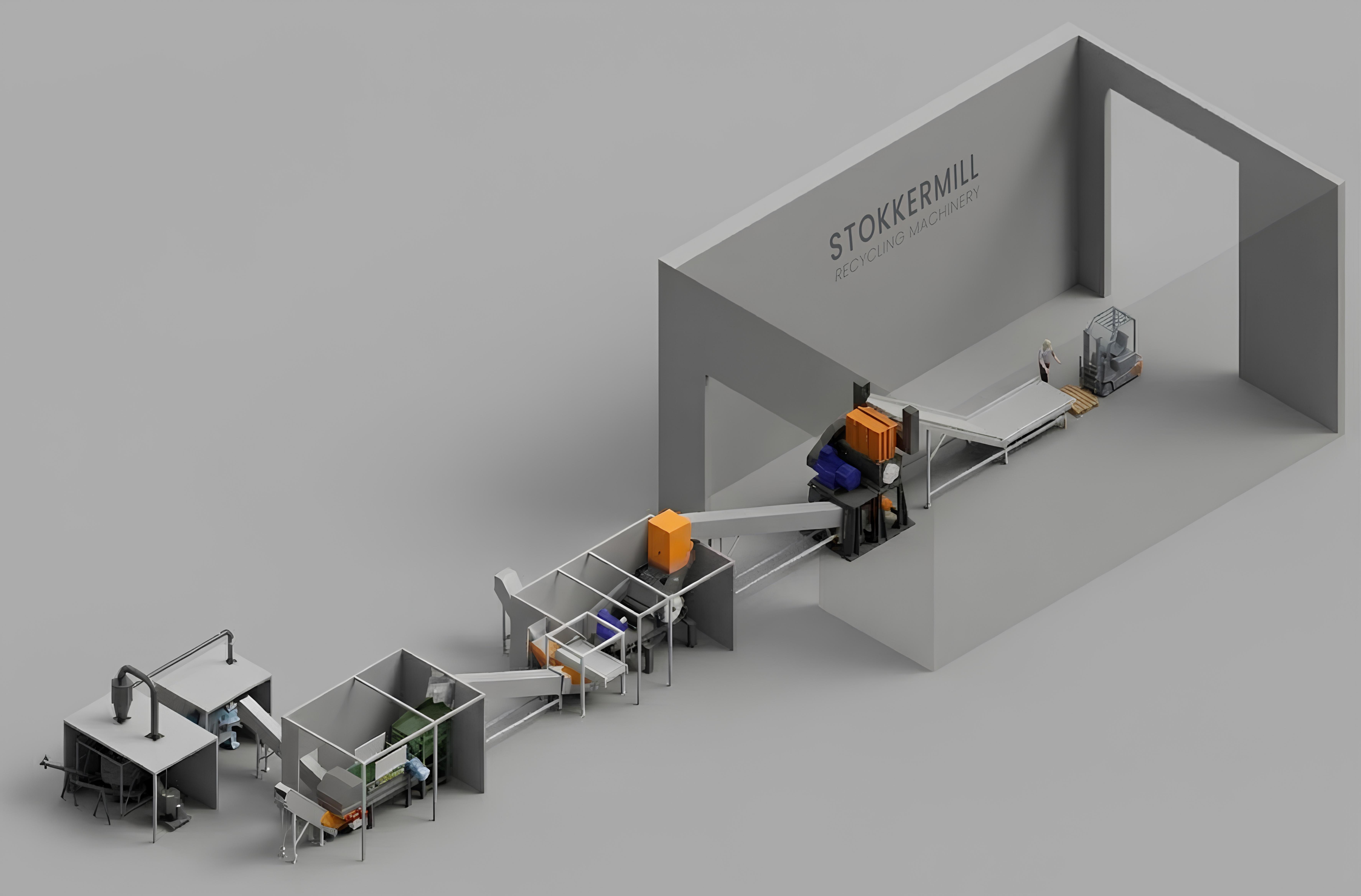
In the photovoltaic panel recycling sector, the growing volume of end-of-life (EoL) modules is forcing a reassessment of traditional operating models. Among these, preventive mechanical de-framing is still widely used, yet it shows significant limitations in terms of productivity, output quality, and scalability.
A technical analysis of industrial processes clearly demonstrates that this approach is no longer suited to the needs of a rapidly evolving market, which is increasingly oriented towards automated, high-efficiency systems.
StokkermillSolar develops and implements an integrated processing approach, where the panel is treated as a whole. This enables simultaneous optimisation of material recovery rates and overall plant performance.
Processes based on frame removal represent an operational model that, although still common, shows clear structural limitations:
In an industrial context increasingly driven by process continuity and standardised output quality, this approach is progressively falling out of alignment with market requirements.
Technological evolution in photovoltaic module recycling is now driven by the integration of density-based separation systems, optical sorting technologies, and eddy current separators.
These Stokkermill technologies enable:
The result is a stable, continuous, and industrially optimised process.

A key element in the process is the quality of recycled glass from photovoltaic panels, which represents one of the main value drivers of the entire plant.
Within the Stokkermill Solar integrated treatment process, glass is liberated and separated in a controlled manner, enabling:
The integration of advanced optical sorting systems and eddy current separators allows the production of glass fractions with very high purity levels, typically exceeding 90–95% and, under optimal conditions, approaching near-zero metallic contamination. This makes the material suitable for high-value industrial reuse.
Conversely, manual or semi-manual processes do not allow uniform impurity control, directly impacting the final quality of the glass fraction and its economic value.
From an operational standpoint, the integrated Stokkermill approach overcomes the typical limitations of manual processing.
An entry-level plant can achieve a processing capacity of 80–100 panels per hour, ensuring:
The rationalisation of processing stages and the integration of technologies significantly reduce energy losses typical of discontinuous or labour-intensive systems.
As a result, productivity aligns with industrial-scale requirements, making the model both scalable and sustainable over the long term, including from an energy efficiency perspective.
The photovoltaic recycling market is expected to grow rapidly in the coming years. In this scenario, technology choices become critical to ensuring competitiveness and profitability.
The adoption of advanced technologies is no longer optional, but a necessary condition for operating in an increasingly structured and demanding market.
29/04/2026
This website uses cookies
We use cookies to improve user experience, analyse site traffic and personalise content. By clicking "Accept all" you consent to the use of all cookies. You can manage your preferences via "Cookie settings". For more information, read our Cookie Policy.
Strictly necessary cookies
Required for the website to function. No consent needed.
Analytics cookies
Google Analytics — anonymous statistics about site usage.
By continuing to browse without making a selection, you consent only to strictly necessary cookies. Read our Privacy Policy and Cookie Policy. You can update your preferences at any time from the footer of this website.