


We develop the best technologies for recycling materials to find innovative solutions for the energy and ecological transition
STOKKERMILL | SELTEK SRL © 2023 | P. Iva. IT02360630301 | Privacy | Terms








Solar panels have an average operational lifespan of 20–25 years. The first large wave of installed capacity from the early 2000s is now reaching end-of-life, and the volumes arriving at recycling facilities are growing rapidly year on year. Governments across Europe, North America and Asia are tightening regulations on PV waste disposal, while the demand for recovered materials, particularly glass, silicon, aluminum and copper, is accelerating as manufacturers seek to reduce dependency on virgin raw materials.For recycling operators and industrial investors, the question is no longer whether to invest in photovoltaic recycling infrastructure, but which technology to choose. The answer has a direct impact on operating costs, energy consumption, output material quality and, critically, the environmental credentials of the entire operation.The StokkermillSolar line was designed with all of these variables in mind: a modular, scalable, fully automated recycling plant capable of processing monocrystalline and polycrystalline panels of any size, with or without aluminum frames, intact or damaged, in a single continuous flow.
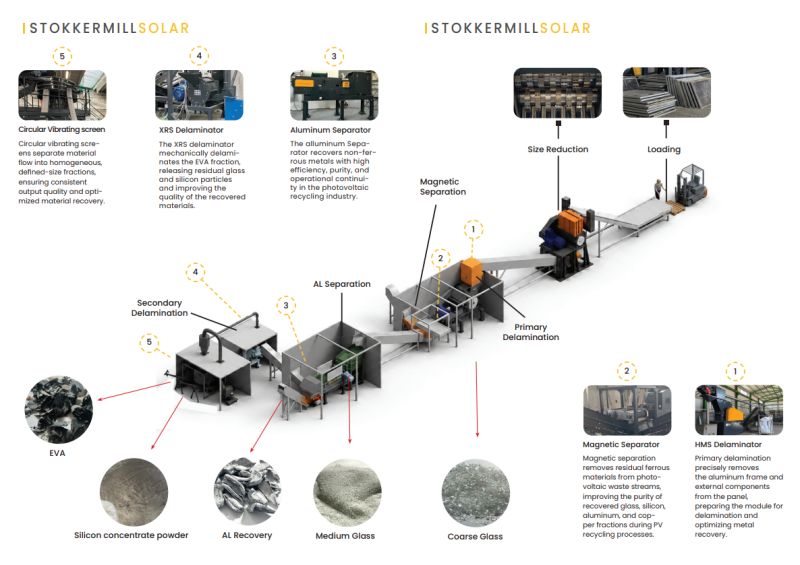
The core of the StokkermillSolar system is a precisely sequenced 5-stage mechanical process. Each stage is engineered to maximize material separation efficiency while minimizing energy input and manual intervention.
Stage 1 — HMS Delaminator (Primary Delamination). The panel enters the line complete with its aluminum frame, no pre-removal required. The HMS performs primary size reduction and delamination, separating the main fractions: coarse glass, aluminum proler and residual components. This eliminates manual pre-treatment, reducing labor costs and processing time significantly.
Stage 2 — Magnetic Separator. An overbelt magnetic system removes ferrous residues from the material stream after primary delamination. This step is critical to improving the purity of all downstream fractions: glass, silicon, aluminum and copper — and ensures output materials meet End-of-Waste compliance standards.
Stage 3 — MFS Aluminum Separator (Non-Ferrous Metal Recovery). The eddy current separator recovers the aluminum proler fraction with high efficiency and operational continuity. The aluminum output is furnace-ready, free of contaminants, and sized correctly for downstream metallurgical processing, maximizing its market value without additional treatment steps.
Stage 4 — XRS Delaminator (Secondary Delamination and Silicon Concentration). The technological heart of the line. The XRS mechanically separates the EVA encapsulant layer, releasing the silicon and fine glass fraction trapped within. The entire process runs at ambient temperature, no thermal treatment, no emissions requiring special authorization. Wear-resistant design ensures minimal downtime and consistent 24/7 throughput.
Stage 5 — Circular Vibrating Screen (Granulometric Classification). The vibrating screen separates the output flow into homogeneous, defined-size fractions, ensuring consistent quality across all recovered materials. Coarse glass (2–8 mm) is directed to the glass industry; medium fractions serve ceramics and steelmaking; silicon concentrate powder — containing silver traces — is valorized in specialist industrial channels.
A standard photovoltaic panel weighing approximately 20 kg contains a range of recoverable materials. The StokkermillSolar process extracts each fraction with high purity and without cross-contamination, making them directly reusable by downstream industries.Glass is the largest fraction by weight. The coarse fraction (2–8 mm) is clean, low in iron content and reused directly by the glass industry. The finer fraction finds application in ceramics, steelmaking and construction materials. Aluminum exits the process as furnace-ready proler, compliant with End-of-Waste standards and ready for metallurgical reprocessing without further cleaning. Silicon concentrate powder — the finest fraction — contains traces of silver and other conductive metals, making it a material of growing industrial interest. EVA and back-sheet polymers, substantially free of glass and contaminants, are recovered as alternative fuel given their high calorific value. Copper, though representing only approximately 1.2% of panel weight, carries significant economic value and is fully recovered through the separation sequence.Together, these fractions account for up to 99.8% of the panel's input weight — a recovery rate that places StokkermillSolar among the most material-efficient photovoltaic recycling solutions available on the market today.
Selecting the right photovoltaic recycling technology is a long-term strategic decision. The key variables to evaluate are processing capacity (kg/h or panels/h), input flexibility — can the system handle damaged panels, different sizes, double-glass modules? — output quality, meaning whether the recovered fractions are marketable without further processing, and total cost of ownership, combining capex, opex, energy and maintenance.The StokkermillSolar line addresses all of these criteria. It processes panels of any size, monocrystalline and polycrystalline, with or without frames, intact or broken, without any prior manual sorting. The system is fully automated and designed for continuous industrial operation, with low maintenance requirements and a modular architecture that allows configuration to the specific throughput and output specifications of each customer.
With over 30 years of experience in industrial recycling machinery and installations in more than 60 countries, Stokkermill offers not just equipment, but a complete technical partnership — from initial plant design and installation through to operator training and after-sales support. Whether you are evaluating your first photovoltaic recycling investment or looking to upgrade an existing operation, our engineering team is available to analyze your specific requirements and propose the configuration that delivers the best return on investment.
This website uses cookies
We use cookies to improve user experience, analyse site traffic and personalise content. By clicking "Accept all" you consent to the use of all cookies. You can manage your preferences via "Cookie settings". For more information, read our Cookie Policy.
Strictly necessary cookies
Required for the website to function. No consent needed.
Analytics cookies
Google Analytics — anonymous statistics about site usage.
By continuing to browse without making a selection, you consent only to strictly necessary cookies. Read our Privacy Policy and Cookie Policy. You can update your preferences at any time from the footer of this website.