



1. A market moving faster than usual
Over the past few months, looking at the European and American markets, the cable recycling machinery sector has taken a substantial leap forward. This is not the usual incremental growth the industry is used to: buyer demand has shifted decisively towards higher-throughput systems, which are nonetheless expected to handle processing challenges that are considerably more complex than in the past.
2. Increasingly mixed materials, no longer a standard stream
The cable stream reaching a plant today is anything but uniform. Just think of TECK cables, widespread in North America and Canada, with their metal armour and multilayer structure, or of batches heavily contaminated with metals other than copper or aluminium — iron, lead, mixed alloys, in proportions that change from one load to the next. Anyone designing a plant today can no longer reason in terms of a “standard cable”.
3. What plant buyers really want today
Market demand is moving in two directions that must coexist rather than compete. On the one hand, automation: reducing direct human intervention on the line and centralising process control in a single supervision point. On the other, the ability to precisely separate the metals and materials that contaminate the cables, while still maintaining high output quality — never one at the expense of the other. The challenge lies exactly where these two needs meet.
4. Why pre-shredding, granulation and separation are no longer enough
This trend inevitably requires moving beyond the conventional approach that has shaped the industry for decades: pre-shred, granulate, separate, in a linear sequence designed for relatively predictable material. With increasingly mixed input, that sequence alone can no longer deliver the throughput or the purity required today. What is needed is a more refined level of separation, capable of distinguishing metal fractions that are ever more similar in density and size. Stokkermill is fully part of this change — not watching it from the outside.
5. The technologies we are bringing to Ecomondo 2026
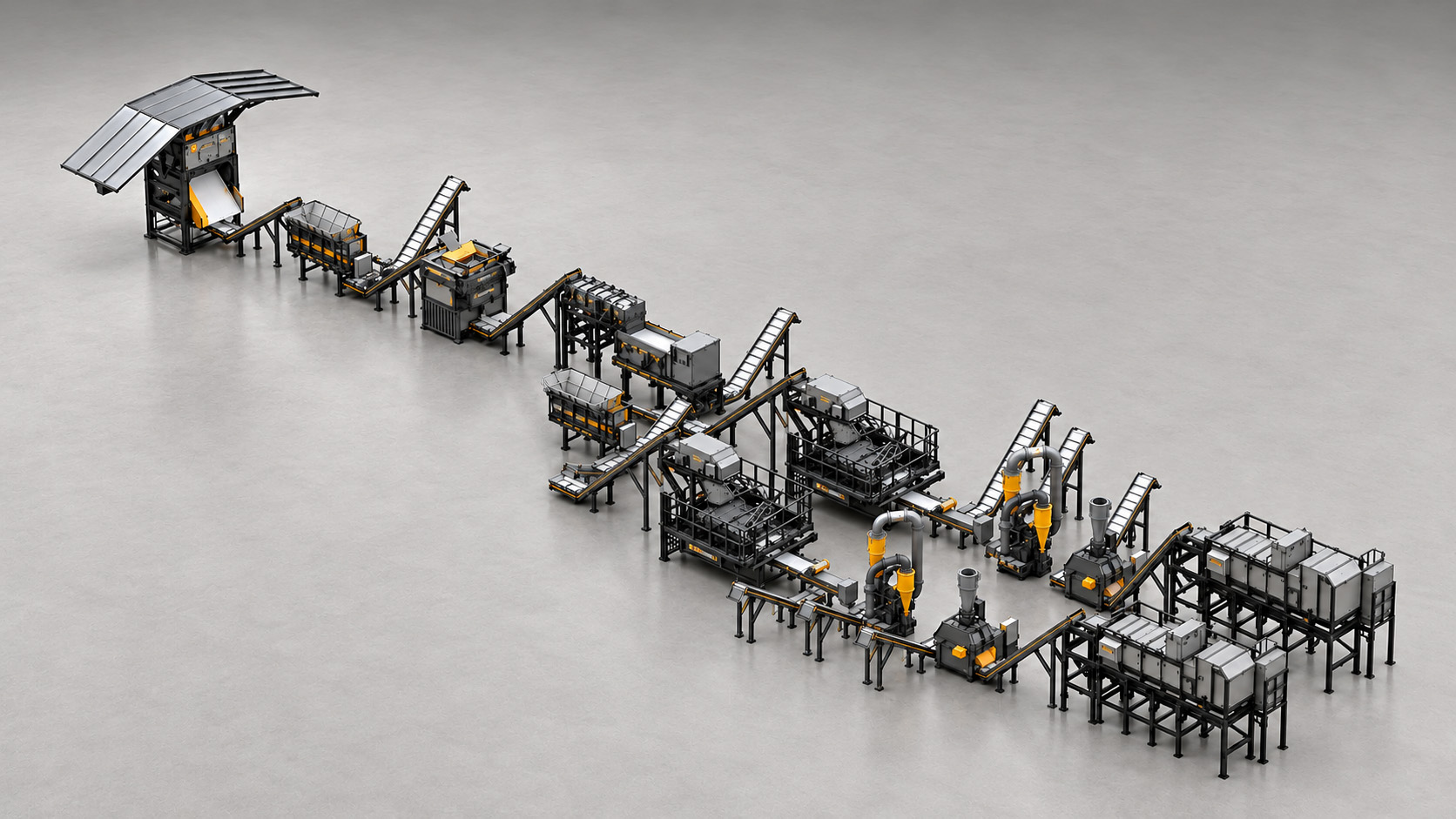
This is where the solutions we will present at Ecomondo 2026 come from: not a single machine, but a set of separation technologies designed to meet these requirements point by point.
- Precision multi-deck density tables, able to separate metals of different sizes within the same stream more efficiently.
- Precision separators with motorised adjustment of the density table’s working angle, to adapt separation in real time to the characteristics of the incoming material, batch by batch.
- Zig-zag air separators, dedicated to isolating the dense, heavy metals that conventional technologies struggle to discriminate.
- High-intensity supermagnets, capable of recovering even stainless steel fractions — a material that almost always escapes conventional magnetic separation.
- Optical and X-ray systems, which further refine the output metals, beyond the limits of density or magnetic separation alone.
6. Leading the evolution, not chasing it
We are not chasing a trend that others have already picked up. It is the same separation logic we have applied for over thirty years, now taken to a level of precision that the market was not yet asking for just a few years ago. This is how we see the role of those who want to remain a benchmark in cable recycling: not following the evolution of the industry, but being among those who define it.
7. What you will see at our stand
At Ecomondo 2026 these technologies will be shown in action, not just on a data sheet: precision tables, air separators, supermagnets and optical systems applied to real cable streams — mixed, and not hand-picked in a laboratory. We still believe a brand is not something you describe — it is something you see.