


We develop the best technologies for recycling materials to find innovative solutions for the energy and ecological transition
STOKKERMILL | SELTEK SRL © 2023 | P. Iva. IT02360630301 | Privacy | Terms








In the precious metals sector, gold and silver are generally associated with their high economic value and with the subsequent melting and refining stages. Before the material reaches the furnace, however, there is another equally important stage: material preparation.
Jewellery, chains, deformed pieces, production offcuts and other materials containing gold or silver can vary considerably in shape and size. For operators handling these materials, making them more compact, manageable and suitable for the next processing stage can be an important part of the overall process.
This is where volume reduction plays a specific role: not as a refining process, but as a mechanical pre-melting preparation stage.
The growing focus on recovering and maximising the value of precious metals is encouraging operators to examine every stage that takes place before melting more carefully.
For a gold-buying business, jewellery-sector operator, precious-metal scrap processor or melting facility, incoming material can be extremely varied:
Mechanical preparation makes it possible to manage this stage without confusing it with the subsequent melting, separation or refining operations.
Reduce Volume
Bulky materials or items with irregular geometries can occupy a large amount of space relative to their mass. Volume reduction produces a more compact material that is easier to handle.
Improve Material Handling
Mechanically prepared material can be transferred, stored and fed into the subsequent processing stages more easily.
Handle Irregular Shapes
Chains, deformed pieces and other metal items can be difficult to manage manually. Twin-shaft technology can grip the material and subject it to controlled mechanical reduction.
Reduce Reliance on Manual Operations
For businesses processing significant quantities of precious material, automating the preparation stage can make the workflow more structured and repeatable.
It is important to distinguish clearly between the different operations. Shredding does not determine the purity of gold or silver and does not replace melting or refining.
The machine’s function is to physically prepare the material for the next stage. The process can be represented simply:
Incoming material → handling and sorting → volume reduction → pre-melting preparation → melting → refining
Gold-buying businesses are one of the points at which precious material enters the value chain that leads to its subsequent recovery and valorisation. The collected material may be sent for melting and then undergo further recovery and refining operations.
In this context, material preparation can become a genuine industrial stage. The objective is not merely to handle the scrap, but to organise its progression through the process until it reaches the melting stage.
For professional operators, this means being able to integrate a dedicated mechanical stage between incoming material handling and subsequent processing.
Critical materials are currently at the centre of European and industrial debate and are often discussed alongside precious metals. However, precision is important: gold and silver are not currently classified as Critical Raw Materials by the European Union under the list established by the Critical Raw Materials Act.
Nevertheless, resource security, circularity and the valorisation of secondary materials — the same principles driving policies on critical raw materials — are becoming increasingly important within the precious metals sector.
For this reason, it is useful to describe gold and silver as strategically important resources: high-value materials that deserve increasingly efficient handling and preparation processes.
Preparing material before melting therefore forms part of a broader trend: improving supply-chain efficiency and maximising the value of a resource that is already available.
The Stokkermill D15 is a twin-shaft shredding solution that can be configured for the preparation of metal materials intended for subsequent melting.
A D15M configuration was specifically proposed for the volume reduction of silver before the melting stage. This configuration features special shortened blades designed to improve grip on the material during processing.
MOTOR POWER: 2 × 4 kW | SPEED: 10–15 rpm | WEIGHT: approx. 700 kg
This documented application confirms a clear principle: the D15 can be used as a preparation machine, reducing the volume of silver material before the subsequent melting stage.
In this application, the value of the D15 does not lie in refining the metal, but in physically preparing the material.
The machine operates upstream of the melting stage and can help transform bulky or irregular material into a form that is easier to handle during the subsequent process.
This approach makes the concept relevant to several types of operator:
When discussing gold and silver, attention naturally tends to focus on melting and refining. However, the quality and efficiency of the workflow also depend on what happens before the material reaches the furnace.
Pre-melting preparation makes it possible to manage the material more systematically, reduce its volume and improve its handling.
For this reason, twin-shaft shredding should not be viewed simply as a recycling technology, but as a technology for preparing precious-metal materials.
The D15M configuration documented for silver provides a practical example of an application within the precious metals sector. The objective is simple and industrially clear: to reduce the material’s volume and prepare it for the subsequent melting stage.
For Stokkermill, the focus is not only on the machine itself, but also on how it is integrated into the overall process:
Prepare the material, reduce its volume and deliver it to the melting stage.
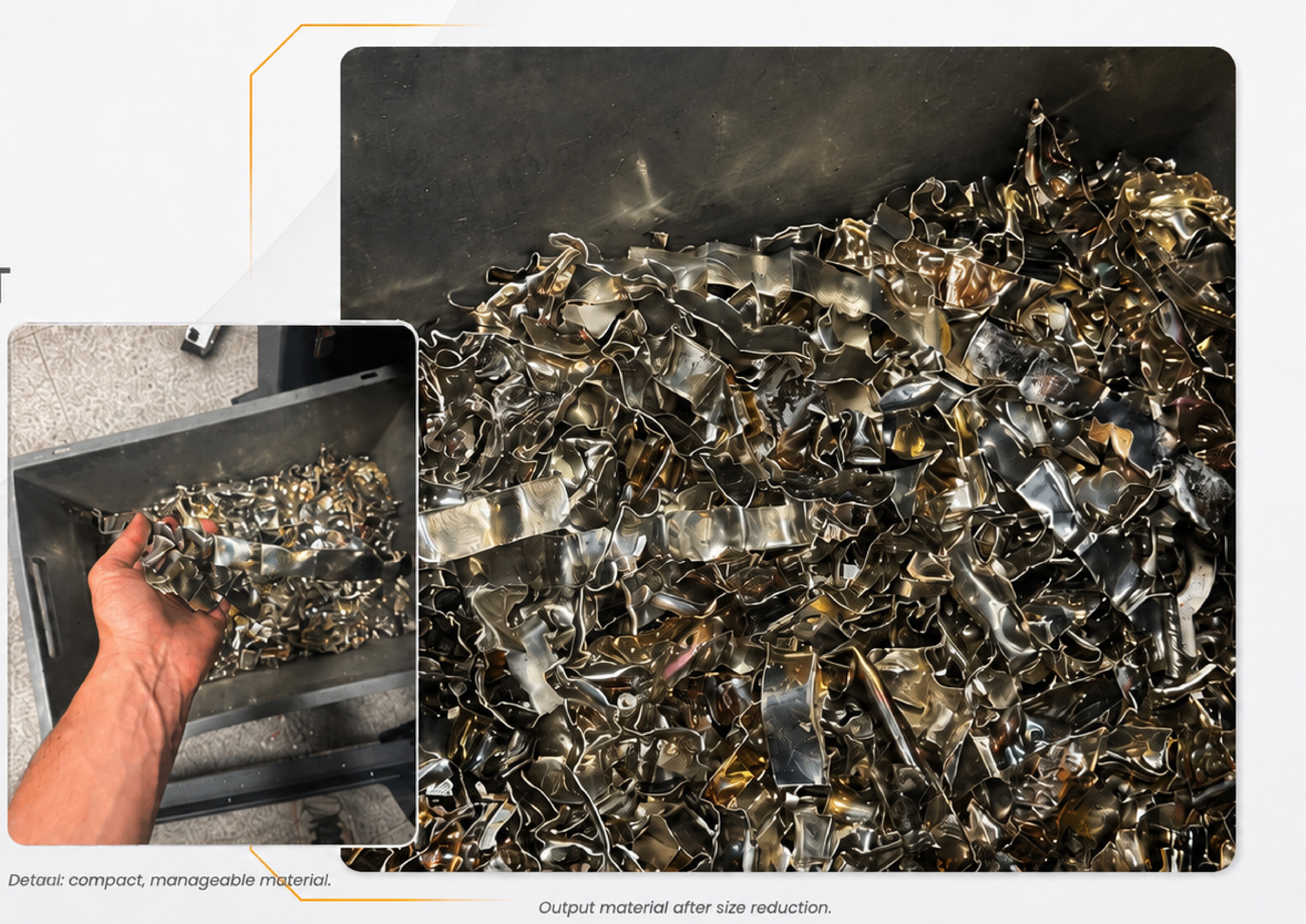
The images show a practical example of the material after processing. The output material has smaller dimensions and a more manageable form than the bulky and irregular metal material originally fed into the machine.
10/08/2026
This website uses cookies
We use cookies to improve user experience, analyse site traffic and personalise content. By clicking "Accept all" you consent to the use of all cookies. You can manage your preferences via "Cookie settings". For more information, read our Cookie Policy.
Strictly necessary cookies
Required for the website to function. No consent needed.
Analytics cookies
Google Analytics — anonymous statistics about site usage.
By continuing to browse without making a selection, you consent only to strictly necessary cookies. Read our Privacy Policy and Cookie Policy. You can update your preferences at any time from the footer of this website.