


We develop the best technologies for recycling materials to find innovative solutions for the energy and ecological transition
STOKKERMILL | SELTEK SRL © 2023 | P. Iva. IT02360630301 | Privacy | Terms







End-of-life electrical cables are an extremely complex and inconsistent feedstock:
This variability requires a structurally stable cable recycling machine equipped with a highly sensitive air density separation table, capable of continuously processing material with different particle sizes.
The machine frame and mechanical assemblies must form a rigid and stable system. This structural rigidity prevents flexing or torsion that could interfere with the combined air and vibration settings and reduce separation efficiency. Low maintenance requirements and straightforward operation are equally important.
Structural rigidity is ultimately a matter of operating hours, not years. A newly installed machine may perform well during its first few hours, particularly when demonstrated using standard cable supplied by the manufacturer.
The real test comes much sooner than many buyers expect. Just 10–20 hours of processing mixed, real-world cable can expose the limitations of a frame that is not sufficiently rigid. The screening deck frame may begin to distort under load, the granulator knives may wear unevenly and produce an inconsistent cut, and the recovered metal granulate may remain contaminated with plastic while the PVC fraction retains metal. At that point, effective separation has essentially been lost.
The most demanding technology markets across the UK, continental Europe and North America have already made a clear distinction on this issue. There are also capable manufacturers in East Asia, but genuine quality has traceable costs: research and development, high-grade components, mechanical engineering and a properly structured manufacturing operation. When these elements are combined, production costs inevitably move closer to European levels.
A simple comparison illustrates the problem. A professional-grade electrical control panel alone can often cost more than the US$3,000–5,000 advertised for an entire machine. Such a low price for a complete cable recycling system is not necessarily a bargain. It usually indicates that compromises have been made somewhere in the bill of materials, electrical safety systems or structural fabrication.
There is also another risk familiar to companies that have purchased machinery from certain suppliers trading through platforms such as Alibaba: sellers who become unreachable after the sale, leaving the buyer without technical support, spare parts or any meaningful warranty beyond the payment already collected.
An entry-level investment can therefore involve very real compromises:
The Stokkermill K750 was developed to bring the structural rigidity and separation principles normally associated with larger industrial cable recycling plants into a compact format.
It is designed for businesses entering the cable recycling industry with a controlled initial investment, without compromising the quality and commercial value of the recovered copper.
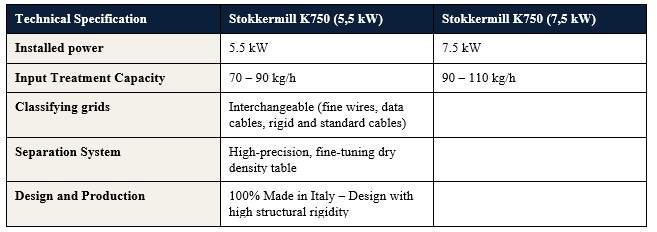
Design and manufacture: 100% Made in Italy, with a high-rigidity structural design.
A quoted purity figure alone says very little about what happens when a component wears out or a spare part is urgently required.
This is where the real difference between an industrial machinery manufacturer and a seller who becomes unreachable after receiving payment becomes clear: the availability of genuine spare parts and accessible technical support in every region where the machine operates.
The same principle applies to a high-end watch. Its value lies not only in the mechanism it contains on the day it is purchased, but also in the authorised service network that supports it throughout its working life, wherever its owner may be.
The principle is even more important for an industrial cable recycling machine expected to operate every day. The machine itself represents only half of the investment’s value. The other half is the organisation that responds when production stops.
On 6 August, the Stokkermill K750 will be showcased at the annual NZAMR convention in Auckland, at Stand 4, in partnership with Pioneer Group.
This is more than a product display. It is a practical demonstration of what genuine global support means: an established local partner providing technical and commercial assistance throughout New Zealand.
Visitors will have the opportunity to examine the machine’s structural strength, assess the quality of the recovered copper granulate and learn more about the international support network behind every Stokkermill cable recycling machine.
29-07-2026
This website uses cookies
We use cookies to improve user experience, analyse site traffic and personalise content. By clicking "Accept all" you consent to the use of all cookies. You can manage your preferences via "Cookie settings". For more information, read our Cookie Policy.
Strictly necessary cookies
Required for the website to function. No consent needed.
Analytics cookies
Google Analytics — anonymous statistics about site usage.
By continuing to browse without making a selection, you consent only to strictly necessary cookies. Read our Privacy Policy and Cookie Policy. You can update your preferences at any time from the footer of this website.