


We develop the best technologies for recycling materials to find innovative solutions for the energy and ecological transition
STOKKERMILL | SELTEK SRL © 2023 | P. Iva. IT02360630301 | Privacy | Terms








On paper, traditional delamination of photovoltaic modules—the meticulous separation of the various layers that make up a panel—seems like the ideal approach. In real-world operations, however, first-generation systems hide an insurmountable limitation: their rigidity. These machines are designed to handle perfectly intact modules and almost always require complex manual or mechanical pre-removal of the outer frame.
Removing the aluminum frame has proven to be a critical bottleneck capable of halting an entire production line. This issue is so widespread that, just in 2025, Stokkermill carried out at least three major upgrades on outdated third-party facilities, replacing old delamination systems to unlock the unutilized production capacity of these plants.
The reality of photovoltaic WEEE (Waste Electrical and Electronic Equipment) treatment shows that panels arriving for disposal are rarely intact; they come in shattered, deformed, and heavily chipped. Feeding a damaged module into a traditional system risks constant jams and premature wear.
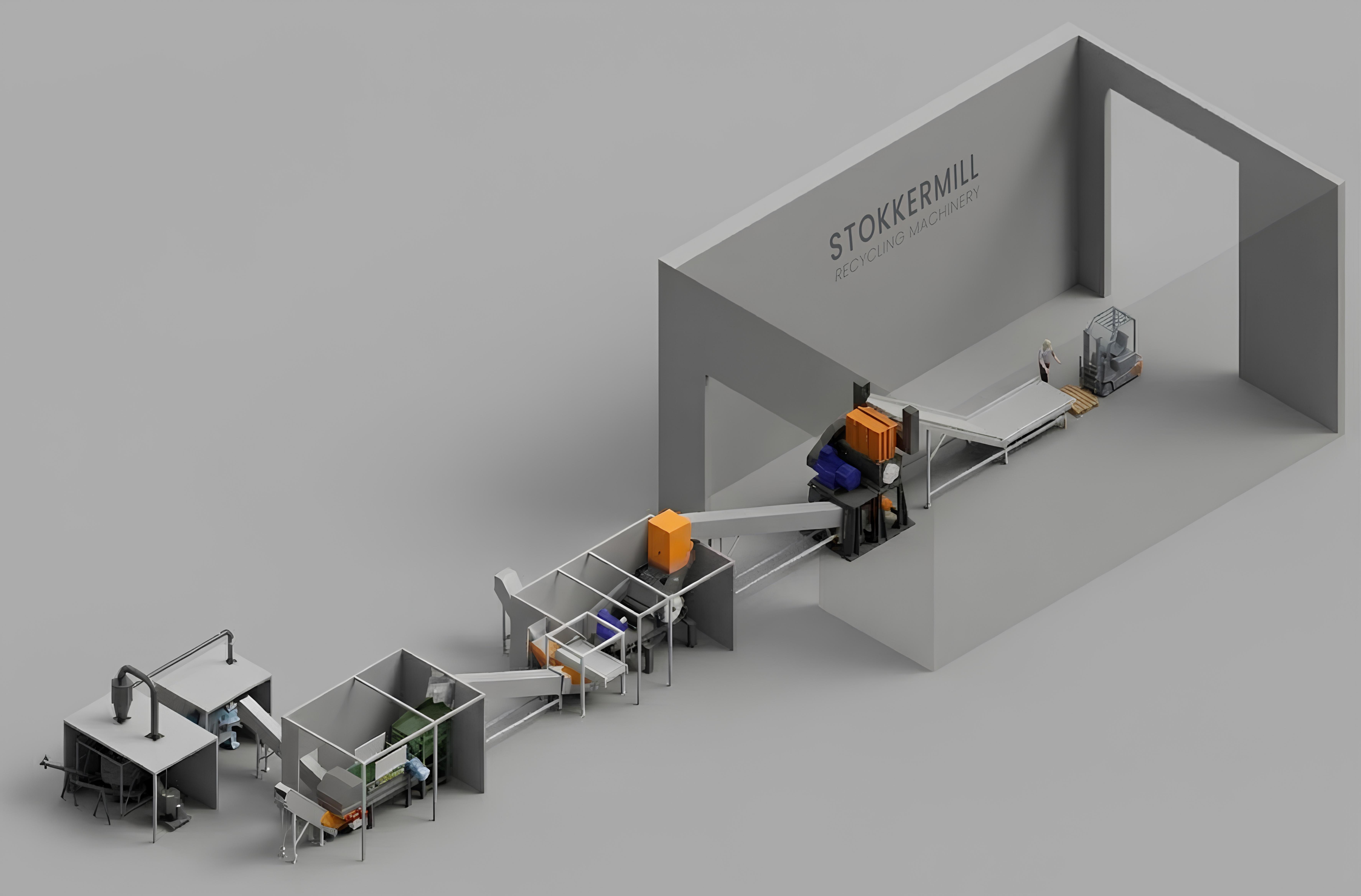
To overcome these structural challenges, the ultimate solution is the integral volumetric process developed by Stokkermill, based on pure mechanical robustness.
Using machinery designed for intensive wear—such as the HMS Primary Delaminator—allows the line to process any type of incoming material without pre-treatment. Whether the panels are broken, framed or frameless, single-sided or double-sided, the system ensures uninterrupted 24/7 operation, drastically reducing downtime and maintenance costs.
The efficiency of a modern plant is measured by its ability to maximize the value of secondary raw materials. Standard delamination systems often return aluminum frames whole, a material considered low-grade by smelters due to contamination from adhesives and screws, resulting in significant devaluation.
The Stokkermill process shreds and densifies aluminum into 40–70 mm granules, or “proler.” This product is perfectly clean, furnace-ready certified, and can be sold at peak market value.
Advanced lines, like Stokkermill Solar, also include refining modules capable of isolating highly concentrated silicon powders.

While the mechanical part of the process guarantees brute force and operational continuity, integrating optical separation technology provides surgical-level precision. To extract maximum value from glass recovery, Stokkermill developed a dedicated engineering project in close collaboration with an internationally recognized partner, creating a customized system for solar panels.
Once materials are shredded, next-generation optical sorters read the flow in real time, instantly identifying and removing residual polymer fragments such as EVA and backsheet pieces. Thanks to this optical purity, plastic waste is minimized, and the recovered glass gains a dramatically improved commercial positioning.
Market numbers confirm that the shift toward the integral volumetric process is already well underway. Stokkermill’s technology reliability has led to the installation of three new complete plants in Italy alone in recent months—a country that historically leads Europe in photovoltaic recycling innovation.
However, overcoming the limitations of traditional delamination is a global priority. Demonstrating its international technological leadership, Stokkermill already has several strategic installations planned for the first half of 2026 in key markets such as Spain, Poland, Germany, and the United States.
24/02/2026
This website uses cookies
We use cookies to improve user experience, analyse site traffic and personalise content. By clicking "Accept all" you consent to the use of all cookies. You can manage your preferences via "Cookie settings". For more information, read our Cookie Policy.
Strictly necessary cookies
Required for the website to function. No consent needed.
Analytics cookies
Google Analytics — anonymous statistics about site usage.
By continuing to browse without making a selection, you consent only to strictly necessary cookies. Read our Privacy Policy and Cookie Policy. You can update your preferences at any time from the footer of this website.