







Designing a photovoltaic panel recycling plant cannot be based solely on the line’s nominal capacity. Kg/h, panels per hour, level of automation and quality of the recovered materials are fundamental parameters, but they describe only part of the project.
A photovoltaic module is in fact a multi-layer composite material: glass, EVA, silicon cells, tinned copper ribbons and busbars, backsheet and, in most cases, an aluminium frame and a junction box.
These materials are not simply assembled side by side. The inner layers are laminated together and must therefore be liberated, classified and separated through a process consistent with the panel type and the required result.
That is why the right question is not just: how many panels per hour can the plant process? Photovoltaic panel recycling design should consider the entire supply chain.
The photovoltaic recycling chain
- 1Available material
- 2Logistics
- 3Capacity
- 4Technology
- 5Recovered materials
- 6Destination
1. How to choose a photovoltaic panel recycling plant
There is no configuration that suits every project equally. Before defining the technology, you need to know at least:
- quantity of material available;
- panel types;
- physical condition of the modules;
- frequency of deliveries;
- planned operating hours;
- required level of automation;
- desired quality of the recovered fractions;
- possible destinations for the output materials.

An operator handling relatively small volumes of standard modules has different requirements from a large industrial centre that must manage continuous flows, damaged panels, bifacial modules, glass-glass modules or non-standard materials.
That is why Stokkermill Solar does not base the choice of technology solely on nominal throughput. Input, volume and required output must be assessed together.
2. How to calculate the capacity of a photovoltaic panel recycling plant
The capacity of a plant can be expressed in kg/h or panels per hour. However, the figure must always be interpreted in relation to real operating conditions. The elements to assess include:
- tonnes available during the year;
- operating days and hours;
- continuity of deliveries;
- storage capacity;
- panel characteristics;
- any material peaks;
- possible future growth in volumes.
A high-capacity line can end up under-used if the quantity of material available does not allow a sufficiently continuous feed. Conversely, a line designed for small volumes can become a bottleneck when the operator has to handle large decommissioning, revamping or repowering campaigns.
The right capacity is therefore not necessarily the highest one. It is the one consistent with the material actually available and the plant’s operating model.
3. What technologies are used for photovoltaic panel recycling?
Different technological approaches are used in photovoltaic module recycling. Stokkermill Solar works mainly with two process logics:
- thermo-mechanical delamination, suitable for specific panel types and smaller volumes;
- high-throughput shredding, liberation and separation, designed for automatic industrial configurations and for larger, more variable flows.
They are not necessarily two opposing philosophies. In mature plants, the different technologies can even become complementary depending on the material and the commercial objectives.
The choice must start from the real conditions of the project, not from the technology considered in isolation.
4. Delamination or shredding: which process to choose?
Delamination is a targeted solution above all when the flow has sufficiently controlled characteristics. In dedicated Stokkermill platforms, the panel is prepared by removing the frame and junction box and is then delaminated. These configurations are particularly suited to small volumes and standard monofacial modules.
When capacity, variability and input complexity increase, an automatic platform based on size reduction, liberation and separation makes it possible to handle a wider range of panels.
The question should therefore not be: delamination or shredding? But: which process is consistent with the material, the volume and the required outputs?
5. How much does logistics matter in photovoltaic panel recycling?
Logistics must also be considered in the design. Modules have to be collected, handled, stored and fed to the line. Logistics conditions change depending on quantities, the supply area and how often material arrives at the plant.
There is therefore no distance or logistics configuration that is valid for every project. The assessment must consider together: available volumes + continuity + storage + line capacity + output destination.
Industrial sizing does not end with the choice of machines: it must be compatible with how material will actually enter the plant and how the recovered fractions will be handled afterwards.
6. What is a dual-use photovoltaic panel recycling plant?
The availability of end-of-life photovoltaic modules can vary over the year. That is why, in the most flexible industrial configurations, it can be useful to reduce dependence on a single flow.
The Solar Automatic Integral System can also be configured to process compatible flows other than photovoltaic panels, including Category 4 WEEE and certain types of aluminium and light metal scrap.
The dual-use concept does not mean feeding any material into the same line. It means designing a technology platform that, when the material’s characteristics allow, can be used for several applications on a common plant base. This can help to:
- diversify supply sources;
- increase utilisation of installed assets;
- reduce dependence on a single flow;
- adapt the process to future market developments.
Compatibility must nevertheless be technically verified for each material.
7. Which materials are recovered from photovoltaic panel recycling?
A photovoltaic panel contains fractions that differ greatly in mass, characteristics and value. The recycling process aims to separate them in a way that matches their possible industrial destination. We looked at how to assess their quality in our article on materials recovered from photovoltaic panel recycling.
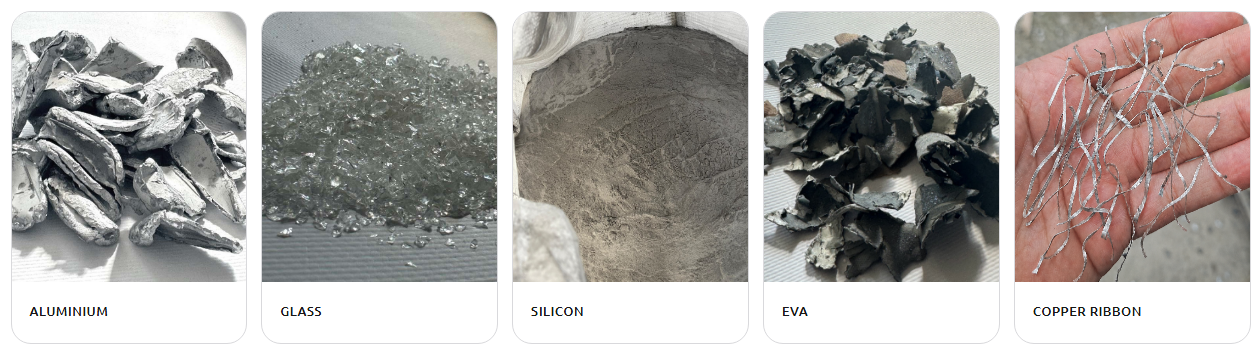
Aluminium
Aluminium is one of the panel’s main recoverable fractions. In Solar Automatic configurations, the process can produce furnace-ready End of Waste aluminium proler, which can go directly to the downstream metallurgical chain.
In Entry Level and Solar Delamination configurations, on the other hand, aluminium is recovered mainly as a profile and may require further processing before it can be sold. The distinction matters: not all plants produce the same aluminium output.
Glass
Glass accounts on average for around 70% of the mass of a standard photovoltaic module. After treatment it can be separated into different particle-size classes, for example coarse glass and medium/fine glass.
However, the quality to be achieved must be linked to the destination market. Increasing purity requires further processing, energy and equipment. The technically highest quality level does not always coincide with the most economically sensible one.
So the question is not only: how clean can we make the glass? But: what quality does the intended destination require?
Copper
Copper can come from the junction box, the external cables and the ribbons inside the laminate. The external fractions can be recovered through the usual non-ferrous metal supply chains.
Copper embedded in the laminate is a different matter: ribbons and busbars are extremely thin and integrated into the EVA-cell-backsheet structure. Their recovery therefore first requires proper liberation of the material.
Concentrated silicon-containing fraction
One of the points that most needs clarity concerns so-called “silicon powder”. The material recovered from treatment is not pure silicon and must not be confused with solar-grade silicon ready for the production of new cells.
It is a concentrated fraction containing silicon together with residual glass and traces of other elements and metals. Its value may also be linked to the presence of metals such as silver, whose concentration varies depending on the technology, the manufacturer and the year the panels were made.
Proper characterisation of the material is therefore more important than a simple commercial label.
EVA and backsheet
The polymer fraction is separated during the delamination, liberation and refining stages. Its characteristics depend on the panel type and the process configuration. Here too, the destination must be assessed according to the actual composition of the fraction obtained.
8. Are recovery and purity the same thing?
No. A high percentage of recovered material does not, on its own, describe the quality of the process. The following must be analysed at the same time:
- quantity recovered;
- purity;
- residual contamination;
- particle size;
- output consistency;
- losses in the other fractions;
- industrial destination.
Glass is a clear example. It is technically possible to push refining further, but each additional stage brings operating costs. If the market does not pay for that higher quality, producing it may not be worthwhile.
The right quality is not necessarily the highest technically achievable quality. It is the quality required by the next destination.
9. How does a Stokkermill Solar plant work?
Stokkermill Solar structures its offering around different plant architectures, developed for different volumes and applications.
PV Entry Level Recycling Line
A semi-automatic configuration for operators with smaller volumes. Indicative capacity is between 500 and 1,000 kg/h, with throughput below around 50 panels per hour, depending on the material.
The process includes panel preparation, recovery of the aluminium frame, removal of the junction box and delamination.
Solar Delamination Line
It adds a subsequent refining process to the delamination stage. It is designed mainly for standard monofacial modules and for operators with relatively small volumes.
Here too, indicative capacity is in the region of 500–1,000 kg/h, with throughput below around 50 panels per hour.
Solar Automatic Integral System
This is Stokkermill’s industrial platform for large volumes. The configuration starts from around 2,000 kg/h and over 100 panels per hour, with the option of developing higher capacities depending on the project.

The system is designed to operate automatically and continuously and can handle a wide variety of modules:
- monofacial;
- bifacial;
- glass-glass modules;
- intact panels;
- damaged panels;
- framed or frameless modules;
- non-standard formats.
The process can integrate size reduction, classification, magnetic separation, non-ferrous metal systems, refining and dedicated physical separations.
Actual performance must always be assessed according to the material and the installed configuration.
10. How to size a photovoltaic recycling plant correctly
Before defining a configuration, it helps to answer a few questions:
- How many tonnes of panels will actually be available?
- Which module types will need to be processed?
- Will the panels arrive intact, damaged or already partly prepared?
- How continuously will the material arrive?
- How many hours a year will the plant need to run?
- Which fractions must be recovered?
- What quality level does the destination market require?
- Will the line need to increase capacity in the future?
- Are there other compatible materials that the platform could process?
This information makes it possible to move from a simple machine request to the design of an industrial process.
11. Photovoltaic panel recycling: designing the process starting from the material
Industrial recycling of photovoltaic modules is not about trying to separate every single component perfectly. The panel is a complex laminated material. The design must therefore connect: INPUT → VOLUME → TECHNOLOGY → LIBERATION → SEPARATION → OUTPUT → DESTINATION.
A line oversized for the available volumes risks being under-used. A technology unsuited to the panel type can create bottlenecks. An extremely refined fraction can lose its economic meaning if the market does not require that quality. And a fraction simply labelled “silicon” can create false expectations if it is not described for what it really is.
That is why Stokkermill starts from analysing the material and the customer’s industrial objectives. It is not about choosing the biggest machine or the most complex process. It is about defining the right configuration to turn a real input into genuinely valuable outputs.
12. Frequently asked questions about photovoltaic panel recycling
What is the capacity of a photovoltaic panel recycling plant?
It depends on the platform and the material. Stokkermill configurations range from semi-automatic lines of around 500–1,000 kg/h to automatic industrial systems starting from around 2,000 kg/h, which can be developed for higher capacities.
Which technology is better: delamination or shredding?
It depends on the project. Delamination is particularly suited to specific panel types and smaller volumes. Shredding and separation platforms are designed for high capacities and more variable inputs.
Which materials are recovered from photovoltaic panels?
The main fractions include aluminium, glass, copper, EVA and a concentrated fraction containing silicon and other elements.
Can the recovered silicon be used to produce new panels?
The fraction obtained from mechanical recycling is not solar-grade silicon. It is a concentrate containing silicon, residual glass and traces of other materials and metals, which may require further refining and recovery processes.
How much glass does a photovoltaic panel contain?
In a standard photovoltaic panel, glass accounts on average for around 70% of the total mass, although the composition varies depending on the technology and construction of the module.
What is a dual-use plant?
It is a configuration in which some sections of the platform can also be used for other flows, where technically compatible. In the case of Solar Automatic, applications on Category 4 WEEE and certain types of light scrap and aluminium can be assessed.
What information is needed to request a plant?
Particularly useful are the panel types, available quantities, input condition, planned operating hours, required capacity and the characteristics of the fractions to be obtained.
02/11/2026