







Infrared Glass Removal System
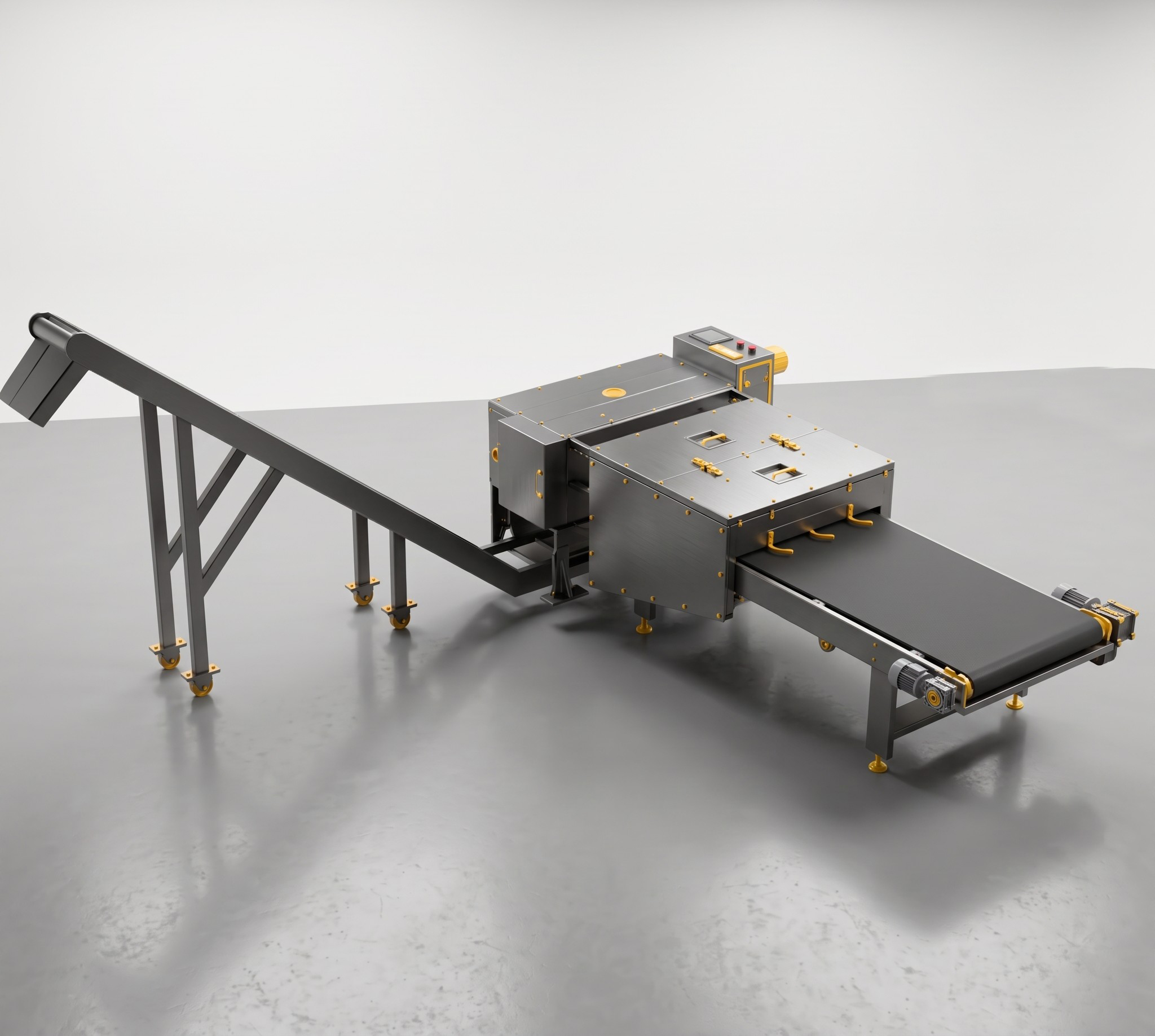
1. General Description
The Integrated Glass Removal System is a closed, self-contained unit designed to process the EVA/backsheet mat coming from the stripping stage, which still contains glass residues (fragments and layers bonded by the EVA). The system operates in an automatic sequence on a conveyor belt: the operator loads the mat at the infeed, the heating and removal process takes place entirely inside the closed system, and the clean mat is discharged at the outfeed ready for collection.
As no melting process is involved, the system does not generate any fumes. Both the heating zone temperature and the belt advance speed are independently adjustable, allowing the cycle to be tailored to different types and conditions of incoming mat. In the infrared lamp configuration, heating is also "intelligent": the lamps self-regulate via inverter, keeping the set temperature stable over time and reducing energy consumption compared with fixed-power operation.
2. Working Principle — Process Cycle
Stage 1 — Feeding. The mat is placed on a low-speed flat conveyor belt positioned at the system infeed, designed to ensure correct feeding even with irregular or partially flexible materials.
Stage 2 — Infrared Heating. The mat enters the heating chamber, where IR emitters bring the material surface to 80–100°C, a temperature sufficient to soften the EVA layer and reduce the adhesion of glass residues, without degrading the mat.
Stage 3 — Mechanical Glass Removal (Scraping). The mat passes under a mechanical scraping unit (heat-treated K110 tool steel) that removes the softened glass residues. The scraper is modular, allowing it to be re-sharpened, and is adjustable in geometry and pressure to suit different material thicknesses and conditions.
Stage 4 — Glass Collection. The removed glass fragments fall onto an internal secondary conveyor belt, which carries them out of the system and discharges them into a dedicated collection container, kept separate from the mat flow.
Stage 5 — Clean Mat Discharge. The mat, now free of glass residues, is discharged at the system outfeed and collected by the operator, ready for commercialisation as a secondary raw material.
3. Design Features
- Modular scraper. Scraping unit made of modular elements, allowing periodic re-sharpening; adjustable in pressure and geometry.
- Synchronised drive. Drive shafts synchronised via a double chain, with an automatic tensioning idler that keeps chain tension constant over time.
- Belt cleaning. Final steel cleaning brush on the belt, positioned downstream of the processing cycle.
- Linear guide travel. Carriages running on linear guides, with shielded, dust-protected bearings to ensure durability and reduce maintenance.
- Extraction. Two extraction points fitted on the machine, for connection to a centralised filtration system (see section 4).
- Inspection. Transparent polycarbonate inspection window, for visual monitoring of the processing cycle without needing to open the system.
- Intelligent IR heating. Self-regulating infrared lamps via inverter, for stable maintenance of the set temperature with optimised energy consumption.
4. Extraction and Filtration System
Given the likely presence of process dust residues during the glass scraping stage, the system is designed to be paired with a dedicated bag filter, connected to the machine's two extraction points.
| Filter type | Bag filter |
|---|---|
| Number of bags | 40 |
| Extraction motor power | 11 kW |
| Connected extraction points | 2 (fitted on the machine) |
| Function | Capture and filtration of dust generated during the mechanical glass removal stage |
5. Main Technical Features
| System type | Closed conveyor belt system with integrated IR module and scraping module |
|---|---|
| Mat feeding | Manual (operator) on flat infeed belt |
| Heating technology | Short/medium-wave infrared, self-regulating lamps via inverter |
| Operating temperature (IR zone) | 80°C – 100°C (adjustable) |
| Installed IR heating power | 37 kW |
| Conveyor belt speed | Adjustable — low speed to optimise heat treatment |
| Glass removal unit | Modular, adjustable mechanical scraper (heat-treated K110 tool steel) |
| Drive | Synchronised shafts with double chain and automatic tensioning idler |
| Belt cleaning | Final steel brush |
| Travel | Carriages on linear guides, shielded bearings with dust protection |
| Inspection | Transparent polycarbonate window |
| Removed glass collection | Internal secondary belt discharging into an external container |
| Extraction | Two extraction points fitted |
| Dust filtration | Bag filter, 40 bags, 11 kW motor |
| Mat discharge | Manual at system outfeed (operator) |
| Guards and safety | Closed system; anti-contact guards on moving parts; emergency stop |
| Power supply | 400 V / 50 Hz / Three-phase (total power to be defined) |
| Emissions | No fumes: the process does not involve melting the material |
| Indicative footprint (L x W x H) | 5200 x 2500 x 1700 (h) mm |
| Indicative weight | To be defined according to final configuration |
| Compliance | CE — Machinery Directive 2006/42/EC |
6. Operational Benefits
- Fully enclosed process: no dispersion of dust or glass fragments into the working environment.
- No fumes: the material is not melted, only heated to soften the EVA.
- Targeted, efficient IR heating, with intelligent lamps that self-regulate via inverter to reduce consumption while keeping the temperature stable.
- Independently adjustable temperature and advance speed, to suit different types of mat.
- Modular, re-sharpenable scraper, for long service life with low maintenance costs.
- Robust, consistent drive thanks to automatic chain tensioning.
- Protected mechanical components (shielded bearings, dust protection) to reduce maintenance and increase service life.
- Visual process monitoring via the inspection window, with no interruption to the cycle.
- Clear separation of material flows: mat and glass collected separately.
- EVA/backsheet mat recovered intact and ready for commercialisation.
